
From groundbreaking designs to iconic red-carpet glamour, these shapeshifters have not only put India on the global map but also created a niche through their distinctive personal styles.
From groundbreaking designs to iconic red-carpet glamour, these shapeshifters have not only put India on the global map but also created a niche through their distinctive personal styles.

There is no guarantee that if we speak in only Indian languages, all our faults will be washed away and India will shine. Why then do they bully and belittle the English-speaking? asks Shyam G Menon.

The prime minister said humanity is facing its most serious crisis in many decades and that NAM can help promote global solidarity as it has often been the world's moral voice.

In today's dynamic economic landscape, commerce and management education is crucial for a global career, says Nayagam PP.

Jaishankar emphasised that the stability of the Middle East region was essential because about one crore Indian citizens live there and said, "a large part of our shipping passes through this region and also, oil comes from there."

We must bring a laser focus on our own interests, and define our friends and foes more clearly instead of trying to live by somebody else's rules. We must grow up, think for ourselves, think India First, asserts R Jagannathan.
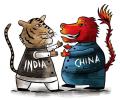
Chinese manufacturing prowess and its dominance in the strategic sector will have a bearing on India's growth projection in the medium term and its march to become a developed nation by 2047, the Economic Survey said on Friday. The Survey has said India needs to grow at 8 per cent for about two decades to become a developed nation by 2047, but it will have to face challenges from global developments and reliance on Chinese imports.
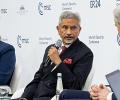
India's External Affairs Minister S Jaishankar countered a US senator's claim that democracy does not put food on the table, citing India's PMGKAY program which provides food to 800 million people. Jaishankar argued that different parts of the world have different experiences with democracy and that the model of globalization has contributed to issues with democracy in some regions. He emphasized that India's democratic system effectively delivers food security, highlighting the PMGKAY program as an example.
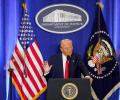
Unless something changes, Mr Trump is a huge threat right now, which is perhaps not being recognised fully, cautions Debashis Basu.

'When Prime Minister Modi met President Trump, they agreed to initiate a bilateral trade dialogue.' 'It makes sense to give these negotiations a chance.'

Globalisation with small government has not been a successful pairing.

If Beijing succeeds in this multipronged effort to challenge the current dominant power, it will have not just economic but political and security consequences. There is no let-up in the South China Sea nor any de-escalation moves on the India-China border. This portends to ominous signalling from Beijing, observes China expert Srikanth Kondapalli.

The resilience of the economy and strength of domestic demand will continue to make India an engine of growth amid the rapidly evolving global trade landscape as a result of US tariffs, Finance Minister Nirmala Sitharaman said in London on Tuesday.
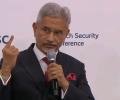
Jaishankar said that India is a democratic society and gives nutrition support to 800 million people. He noted that there are parts where democracy is working well and there could be parts where it is not. However, he underscored that it is should not considered a universal phenomenon.

India and China have made "some progress" in disengagement, External Affairs Minister S Jaishankar said on Sunday, describing it as a "welcome" move which opens up the possibility that other steps could happen.
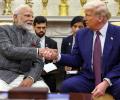
'I certainly hope the two can avoid a trade war and believe they will.' 'I expect some in India will push for retaliatory tariffs if the Trump administration applies significant reciprocal tariffs.'
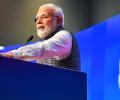
The Indian Diaspora has been able to carve a niche in their adopted countries as a result of their talent, perseverance and hardworking nature, asserts Rup Narayan Das.
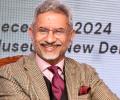
External Affairs Minister S Jaishankar has said India can never permit others to have a veto on its choices and will do whatever is right in the national interest and for the global good without being intimidated to conform. In a video message for a function in Mumbai on Sunday, he said when India is etched more deeply in global consciousness, its repercussions are truly profound. In a world grappling with unhealthy habits, stressed lifestyles or recurring climate events, there is much learning to be gained from India's heritage. But the world will only know when the countrymen take pride in it, he said.

Chinese foreign ministry spokesperson Hua Chunying said Chinese President Xi Jinping called for moving globalisation to a more open, inclusive, universal, balanced and win-win direction.

Modi said India's contribution to global economic growth and prosperity underlined its commitment to 'Building Consensus for Fair and Sustainable Development', which is the theme of the summit.

The old globalisation model is unsustainable. The world economy awaits its new Keynes.
India might benefit from not having globalised as much as the others.

Here is the Brahma Mantra for mankind. So long as the world has leaders with judgement -- humane, compassionate, and no-nonsense in their thinking -- natural intelligence will prevail, notes R Gopalakrishnan.
Amid all the hoopla around India emerging as one of the world's fastest growing economies and figuring in the list of the most attractive destinations being eyed by the World Inc, the country has been named as the second least 'globalised' nation. International consultancy and research firm AT Kearney has ranked India at the 71st position in its annual ranking of the world's most globalised nations, AT Kearney and Foreign Policy Globalisation Index 2007.
A large number of Indians believe that globalisation benefits their country and think that international trade is positive for their economy and the environment, according to a new study.
The United States cherished its relationship with India and both countries should use globalisation as a tool to bring lasting peace and stability in the Indian subcontinent and across the world, former US deputy secretary of state for South Asia, St

A step away from nuclear weapons being used in conflicts, warns Colonel Anil A Athale (retd).
She said the higher education in the country not only needs to expand its capacity but also make substantial qualitative improvement if it has to be the driver of sustainable economic development.

If one looks at them in the perspective of diplomacy, what situation they were in, what mission was given to them, how they had handled the situation, he said.
As the West realizes that globalisation has pauperised governments, left its society in disarray and its currency weak, there is a huge re-think there about the very idea of globalisation.
An interesting excerpt from Virender Kapoor's latest book Inspiring India: Taking India from Big to Great.
The solution to globalisation is decentralisation and the solution to multilateralism is reformed multilateralism, not a 1945-version of multilateralism, External Affairs Minister S Jaishankar has said.

Substantial gains can still be made with good policies and initiatives.
The world's poorest nations have benefitted the least from globalisation and yet suffered the most from the phenomenal downsides, United Nations General Assembly President Sheikha Haya Rashed Al Khalifa said.
We are witnessing a new phase where business leaders are realising globalisation has to take into account national identities and cultures, says Claude Smadja.
If prices remain low the next decade might well see global trade stagnate.
Contrary to the common assumption that Muslims view globalisation as a threat to their society, a new poll has revealed that majority of people adhering to the Islamic faith view the phenomenon positively.Conducted in seven nations with predominantly Muslim populations in different regions of the world, the poll found 63 per cent of the people favouring globalisation for their countries, while only 25 per cent viewing it as bad.
 © 2026 Rediff.com - Advertise with us - Disclaimer - Privacy Policy - Sitemap - Feedback - About us - Terms of use - Grievances